
 Data platforms
Data Platforms
330 Analytics Engineering Questions for dbt Core™ 1.11
Focused practice and timed mock exams
View courseFree practice
Version 2.0 schema patterns, validation, aggregation and indexing, with two 75-question timed practice tests
See the current price and full course details on Udemy. Purchase and learning happen there.
Overview
Questions and explanations: American English
Check the provider’s current objectives before booking your exam. This is independent practice material.
This course contains the use of artificial intelligence.
Choosing a MongoDB model involves more than recognizing a pattern name. A small owned array may suit embedding, while an independently queried history needs a different boundary. A copied value can be a valid historical snapshot or an outdated current-value cache. An index can appear in a plan and still examine far more data than the result requires.
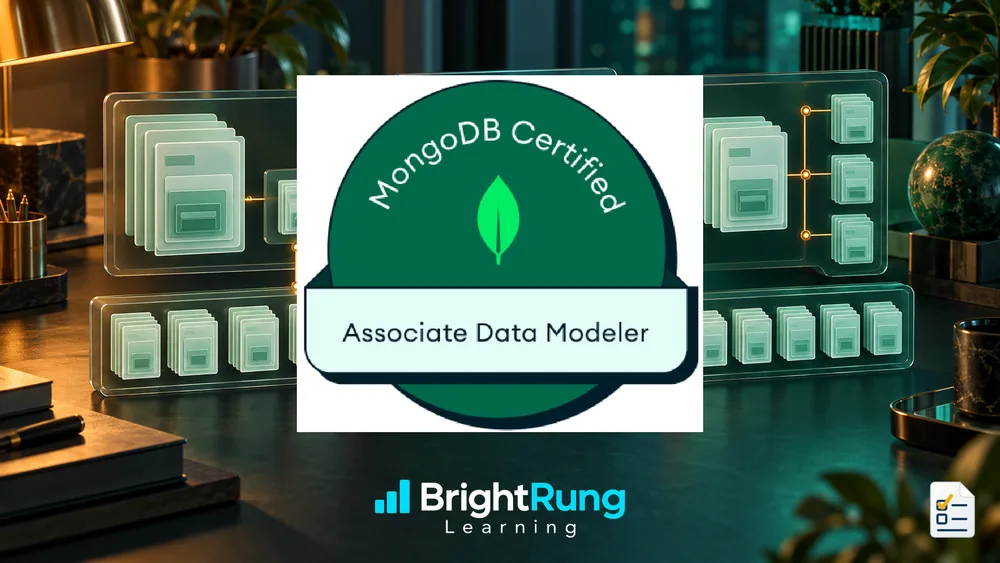
Practice those decisions with 360 original single-answer questions across six tests, aligned to the public MongoDB Associate Data Modeler Exam Guide Version 2.0. AI was used to draft questions and explanations and create the cover background. Review the reasoning and the linked MongoDB learning references as you work through your answers.
What the tests cover
Work through the focused sets before attempting the timed tests. When reviewing a miss, identify the condition that changed the decision: precision, freshness, growth, independent access, update coordination, query grain, or index bounds. Then explain why each alternative fails under that condition. The timed sets include changed constraints and concrete outputs so that remembering a pattern label alone is not enough.
The questions cover Approximation and Schema Versioning, core aggregation and CRUD behavior, embedding and references, data integrity, explain evidence, index costs and ordering, Single Collection, Subset, Bucket, Outlier and Archive patterns, sharded access, Inheritance, Computed values and Extended References, and common growth antipatterns.
The course practice target is 70%. MongoDB does not publish its official passing percentage, so a course score is a study indicator rather than a pass prediction. The official exam may include additional unscored questions. This independent practice course contains no confidential exam questions, hosted lab, exam voucher or booking service and is not endorsed by MongoDB.
Practice sets
54 questions90 minutes
54 questions90 minutes
54 questions90 minutes
48 questions80 minutes
75 questions110 minutes
75 questions110 minutes
FREE COURSE PREVIEW
Three original single-answer questions from this course. Your answers stay in this page and are cleared when you leave.
Continue on Udemy for all practice sets and timed mock exams.
Continue on UdemyQuestions
Use “Continue on Udemy” to open this course on Udemy. Udemy provides checkout, account access and the learning experience.
Inclusion can vary by course, plan and location. Check the current course page and your Udemy plan before purchasing.
No. This is independent preparation material. Certification registration, exam fees and credentials are managed by the exam provider.
Check the course language label. Available language editions are listed on each course page and have separate Udemy links. The website language switch changes navigation, not course content.
Data platformsData Platforms
Focused practice and timed mock exams
 Data platforms
Data Platforms
Focused practice and timed mock exams
 Data platforms
Data Platforms
Focused practice and timed mock exams