
PCPP-32

PCPP1 Python Professional Practice Tests (PCPP-32-101)

360 questions in 6 tests: advanced OOP, PEPs, tkinter, networking, SQLite, XML, CSV, logging and configuration

PythonAmerican English6 套练习

在 Udemy 查看实时价格与完整课程信息,并完成购买和学习。

PCPP1 Python Professional Practice Tests (PCPP-32-101)

课程概览

你将练习的内容

题目及解析语言:American English

考试参考PCPP-32
本课程版本发布日期
核对官方考试资料

预约考试前请核对认证机构的现行目标。本课程为独立练习材料。

  • Diagnose advanced object behavior involving MRO, descriptors, decorators, ABCs, exceptions and copying.
  • Apply PEP guidance to code layout, naming, documentation and type-checking decisions.
  • Trace tkinter callbacks, input validation, Canvas edits, geometry and observable state.
  • Handle socket streams and REST responses while separating status, representation and timeout behavior.
  • Reason about SQLite transactions and process XML, CSV, logging records and INI configuration.
  • Identify weak areas through 270 targeted questions and two independent 45-question timed mocks.

了解完整课程

This course contains the use of artificial intelligence.

You can write Python programs and still be surprised by a cooperative inheritance chain, a property's behavior or a transaction that commits after an error is caught. These practice tests help you explain those outcomes and choose code that satisfies the stated contract.

Prepare for PCPP1: Certified Professional Python Programmer Level 1, PCPP-32-101 with 360 original English questions across six tests. The course follows the active 101 syllabus, whose published revision is March 11, 2022. It does not target the 102 exam currently in development.

Build confidence one area at a time

  • Advanced OOP — 90 questions: attributes, special methods, MRO, decorators, class and static methods, ABCs, properties, built-in subclasses, exceptions, copying and persistence.
  • Coding conventions — 45 questions: PEP purpose and formats, Python philosophy, PEP 8 code style, docstrings and type hints.
  • GUI programming — 60 questions: tkinter callbacks, widgets, Entry validation, Canvas items, geometry, observable variables and state.
  • Networking and files — 75 questions: TCP sockets, REST and Requests, JSON/XML, SQLite, CSV, logging and ConfigParser.
  • Two mixed mocks — 45 questions each: different conditions and combined decisions, with 65 minutes per attempt and section counts of 15/7/8/8/7.

Every question includes an overall explanation, feedback for each choice and a study tip. Code-output questions ask you to follow actual dispatch, state and control flow. The two mocks combine conditions such as subclass construction compatibility, request-body argument precedence, caught transaction exceptions and stale GUI snapshots.

Use the feedback to improve your reasoning

  1. Start with the four targeted tests and explain your answer before submitting it.
  2. Review both your chosen answer and the nearby alternatives. Record the condition that makes each alternative unsuitable.
  3. Run short examples locally where useful, then attempt each mixed mock in one sitting before consulting its feedback.

The 80% practice target is a course setting. The official exam uses a 70% normalized passing score and its own scoring rules; a result here is not an official-score conversion or a prediction of passing. The ten-minute official tutorial/NDA period is separate from the mocks' 65-minute question period.

These are selected-response practice questions, including single-answer and multiple-answer items. They train the syllabus decisions but do not reproduce the official exam's coding or interactive interface. A Python 3.12 environment is used for stated code behavior; version-specific SQLite questions identify that version explicitly.

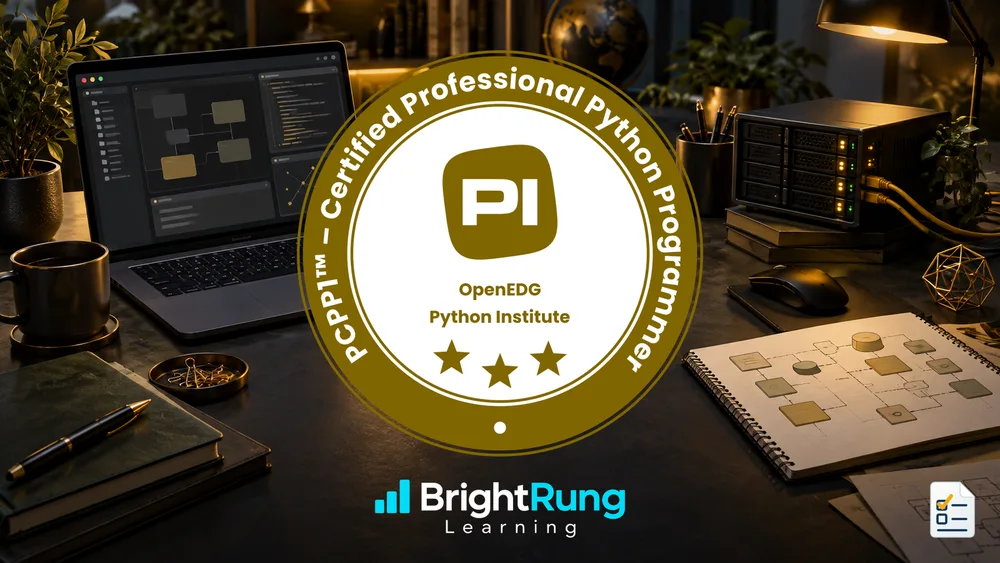
This is independent exam preparation. It is not sponsored, approved or endorsed by Python Institute or OpenEDG, and it contains no recalled or leaked exam questions. The professional badge identifies the certification being studied. A practice-test course is most useful alongside prior Python study and hands-on work, rather than as a complete beginner tutorial.

练习安排

6 套练习. 360 道题.

01

Advanced OOP and Python Object Behavior

90 道题135 分钟

02

Coding Conventions, Docstrings and Type Hints

45 道题65 分钟

03

Tkinter GUI, Events and State

60 道题90 分钟

04

Networking, REST and Structured File Processing

75 道题110 分钟

05

Mixed Mock 1 - PCPP-32-101

45 道题65 分钟

06

Mixed Mock 2 - PCPP-32-101

45 道题65 分钟

免费课程体验

先作答,再理解。

本课程的三道原创单选样题。作答仅在当前页面保留,离开后清除。

选择一个答案1 / 3

A service class declares pending = [] in its class body. Two fresh instances call self.pending.append(item). Where is the appended state stored?

开始前的准备

  • PCAP-level Python knowledge, including functions, classes, exceptions, modules and basic file handling.
  • Familiarity with Python 3; CPython 3.12 is useful for reproducing the explicitly versioned examples.
  • For optional local experiments, an existing tkinter-capable environment and Requests installation.
  • No certification purchase or exam voucher is included or required to use the practice questions.

适合哪些学习者

  • Developers preparing for the active PCPP1 PCPP-32-101 examination.
  • Python programmers moving beyond associate-level syntax into object behavior, GUI and network/file workflows.
  • Learners who want answer feedback that explains the conditions behind plausible alternatives.

常见问题

迈出下一步之前。

在哪里购买和学习?

点击“前往 Udemy”,即可进入对应课程。结账、账号访问和课程学习均由 Udemy 提供。

Udemy 订阅是否包含这门课程?

是否包含取决于课程、订阅方案与所在地区。购买前,请核对 Udemy 实时课程页和你的订阅权益。

是否包含正式认证考试?

不包含。课程是独立备考材料,正式考试报名、费用和证书由认证机构提供。

能否切换课程语言?

请查看课程语言标识。同一考试已上线的语言版本在课程页列出,分别对应独立的 Udemy 课程。网站语言切换只改变导航,不会翻译题库。
PCPP-32360 道题
前往 Udemy